 BirdBrain Academy
Woodpeckers · Picidae
Red-bellied Woodpecker sounds
Melanerpes carolinus
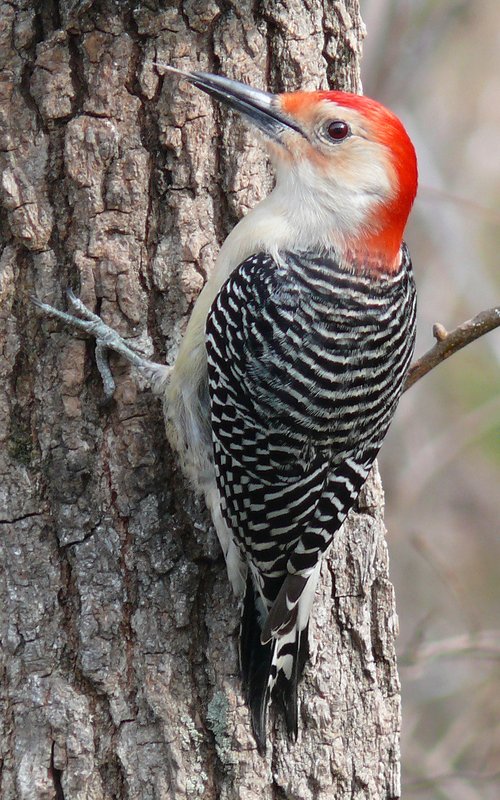
The Red-bellied Woodpecker is a medium-sized woodpecker of the eastern United States, named for its faint reddish lower underside.

Listen to the Red-bellied Woodpecker
Each recording below is a short excerpt with its spectrogram, a picture of the sound. Time runs left to right and higher pitches sit higher up. Play each one, then look for the same shape in the next. Different recordings of the same bird help you learn the bird, not one clip.

Recorded by steve, Chapel Hill, Orange County, North Carolina, 2024-02-09. XC871896 on xeno-canto, CC BY-SA 4.0. Five-second excerpt.

Recorded by Jonathon Jongsma, Minnesota Valley NWR, Old Cedar Ave Bridge, Hennepin, Minnesota, 2013-03-31. XC128005 on xeno-canto, CC BY-SA 3.0. Five-second excerpt.

Recorded by Ryan Douglas, Sweepstakes Rd & Cutstail Dr (near Gaithersburg), Montgomery County, Maryland, 2024-02-11. XC872669 on xeno-canto, CC BY-SA 4.0. Five-second excerpt.
What to listen for
The Red-bellied Woodpecker is noisy, with many varied calls, and both sexes call. Its drumming sounds like about six taps, often used to communicate with potential partners.
Many listeners write its call as “churr-churr-churr”. Treat a written sound as a memory aid; individual birds and regions vary.
What it looks like
Adults are mainly light gray on the face and underparts, with black-and-white barred backs, wings, and tails. Males have a red cap from bill to nape, while females have red patches on the nape and above the bill.
Where to find it
It breeds mainly in the eastern United States, from Florida north to Canada, usually in deciduous forests. It searches tree trunks for arthropods, eats insects, fruits, nuts, and seeds, and nests in decayed cavities of dead trees, old stumps, or softer live trees.
BirdBrain regions that include this bird
- Caribbean
- Eastern Canada
- Florida
- Great Lakes
- Mexico
- Mid-Atlantic
- New England
- Plains
- Rocky Mountains
- Southeast
- Texas
- Western Canada
Did you know?
- The red belly that gives the species its name is difficult to see in field identification.
- They may drum on hollow trees, aluminum roofs, metal guttering, and transformer boxes to communicate.
- Young birds continue giving begging calls when they see their parents for a while after fledging.
Learn the Red-bellied Woodpecker by ear
BirdBrain Academy teaches bird sounds with side-by-side listening and quizzes that use different recordings, so you learn the bird rather than one clip. Start with six free lessons, no signup needed. On your phone, Sound ID can name the birds singing around you.
Related birds
 Downy WoodpeckerWoodpeckers
 Hairy WoodpeckerWoodpeckers
 Northern FlickerWoodpeckers
 Pileated WoodpeckerWoodpeckers
Species notes are adapted from Wikipedia, available under CC BY-SA 4.0, and checked for BirdBrain. Recordings come from xeno-canto under the licenses shown with each one. Photo: Ken Thomas, Public domain, via Wikimedia Commons. Identification guidance is educational; birds vary, so confirm unusual sightings with local experts or eBird.