 BirdBrain Academy
Woodpeckers · Picidae
Downy Woodpecker sounds
Dryobates pubescens
The Downy Woodpecker is North America's smallest woodpecker, living in forested areas across much of the United States and Canada.

Listen to the Downy Woodpecker
Each recording below is a short excerpt with its spectrogram, a picture of the sound. Time runs left to right and higher pitches sit higher up. Play each one, then look for the same shape in the next. Different recordings of the same bird help you learn the bird, not one clip.

Recorded by Jonathon Jongsma, Bancroft Neighborhood, Minneapolis, Hennepin County, Minnesota, 2016-04-19. XC320358 on xeno-canto, CC BY-SA 4.0. Five-second excerpt.

Recorded by Jonathon Jongsma, Dordt College Prairie, Sioux, Iowa, 2012-12-24. XC115432 on xeno-canto, CC BY-SA 3.0. Five-second excerpt.

Recorded by Jonathon Jongsma, Dordt College Prairie, Sioux, Iowa, 2012-12-24. XC115431 on xeno-canto, CC BY-SA 3.0. Five-second excerpt.
What to listen for
The Downy Woodpecker gives several vocalizations, including a short pik call and a rattle-call like a bouncing ball. It also drums with its beak, sounding like four taps, slower than other North American woodpeckers.
Many listeners write its call as “pik”. Treat a written sound as a memory aid; individual birds and regions vary.
What it looks like
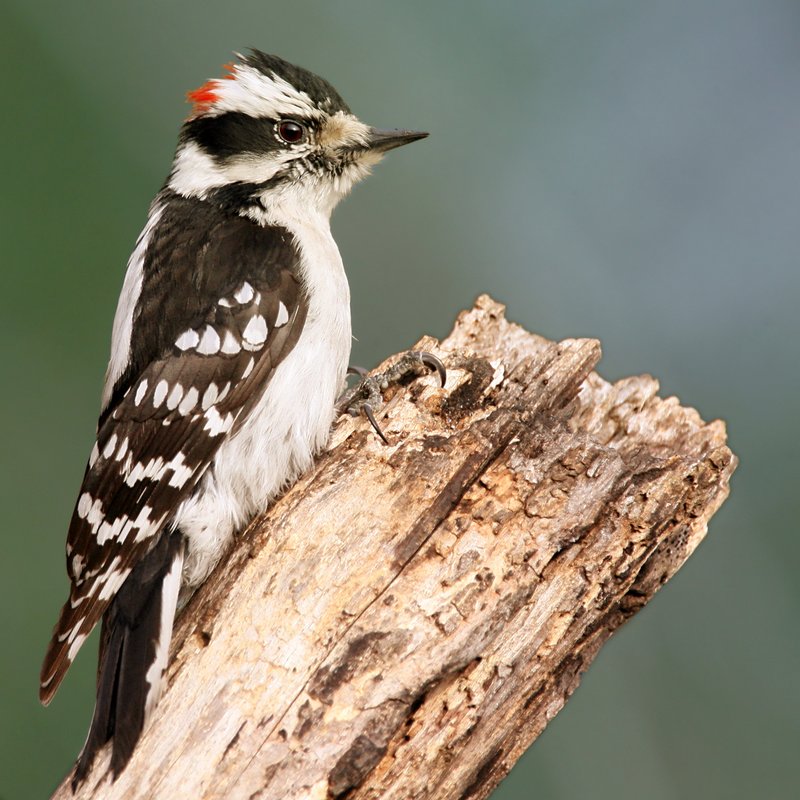
Adults are small, mostly black above with a white back, throat, and belly, white wing spotting, and white bars above and below the eye. Males have a red patch on the back of the head, and the black tail has white outer feathers barred with black.
Where to find it
The Downy Woodpecker is native to mainly deciduous forested areas across most of the United States and Canada, except southwestern deserts and northern tundra. It nests and roosts in tree cavities, often using soft snags or dead limbs where heartwood is easier to excavate.
BirdBrain regions that include this bird
- Alaska
- California
- Caribbean
- Eastern Canada
- Florida
- Great Lakes
- Mexico
- Mid-Atlantic
- New England
- Northwest
- Plains
- Rocky Mountains
- Southeast
- Southwest
- Texas
- Western Canada
Did you know?
- Northern birds may move farther south, while mountain birds may move to lower elevations.
- In winter, they roost in tree cavities.
- They forage on bark surfaces in summer and dig deeper in winter.
Learn the Downy Woodpecker by ear
BirdBrain Academy teaches bird sounds with side-by-side listening and quizzes that use different recordings, so you learn the bird rather than one clip. Start with six free lessons, no signup needed. On your phone, Sound ID can name the birds singing around you.
Related birds
 Hairy WoodpeckerWoodpeckers
 Northern FlickerWoodpeckers
 Pileated WoodpeckerWoodpeckers
 Red-bellied WoodpeckerWoodpeckers
Species notes are adapted from Wikipedia, available under CC BY-SA 4.0, and checked for BirdBrain. Recordings come from xeno-canto under the licenses shown with each one. Photo: Wolfgang Wander, CC BY-SA 3.0, via Wikimedia Commons. Identification guidance is educational; birds vary, so confirm unusual sightings with local experts or eBird.