 BirdBrain Academy
Woodpeckers · Picidae
Northern Flicker sounds
Colaptes auratus
The Northern Flicker is a medium-sized woodpecker native across much of North America and one of the few migrating woodpeckers.

Listen to the Northern Flicker
Each recording below is a short excerpt with its spectrogram, a picture of the sound. Time runs left to right and higher pitches sit higher up. Play each one, then look for the same shape in the next. Different recordings of the same bird help you learn the bird, not one clip.

Recorded by Jonathon Jongsma, Blue Bell Campground, Custer State Park, South Dakota, 2012-06-22. XC104536 on xeno-canto, CC BY-SA 3.0. Five-second excerpt.

Recorded by Jonathon Jongsma, Four Mile Draw Rd, Custer State Park, South Dakota, 2015-06-25. XC254591 on xeno-canto, CC BY-SA 4.0. Five-second excerpt.

Recorded by Jonathon Jongsma, Blue Bell Campground, Custer State Park, South Dakota, 2012-06-22. XC104536 on xeno-canto, CC BY-SA 3.0. Five-second excerpt.
What to listen for
The Northern Flicker gives a sustained, laughing call rendered as "ki ki ki ki." It also drums on trees or metal objects to communicate and defend territory.
Many listeners write its call as “ki ki ki ki”. Treat a written sound as a memory aid; individual birds and regions vary.
What it looks like
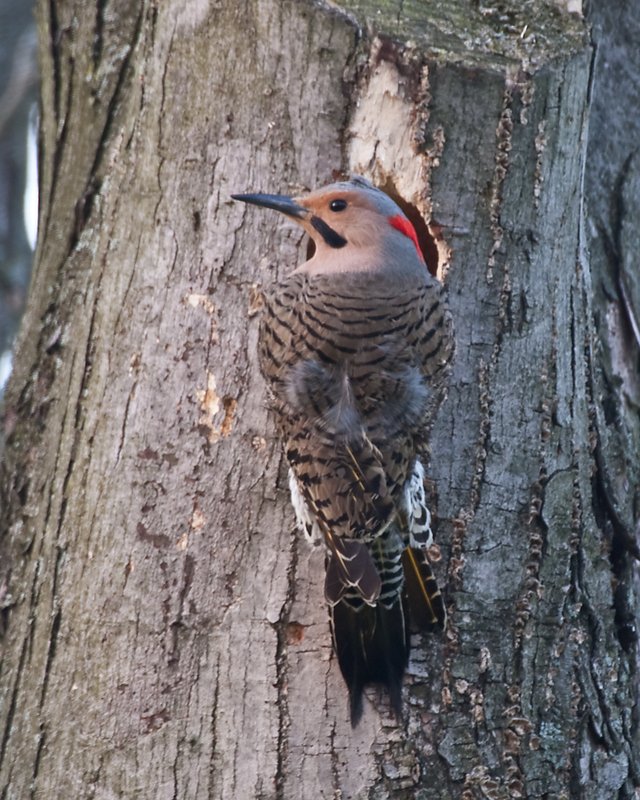
Adults are brown with black bars on the back and wings, with a necklace-like black patch on the upper breast and spotted beige underparts. In flight, the dark tail gives way to a conspicuous white rump; males show a black or red mustachial stripe, while females lack it.
Where to find it
The Northern Flicker lives in open habitats near trees, including woodlands, edges, yards, parks, and western mountain forests up to the tree line. It usually nests in tree holes, though it may use old earthen burrows, with both sexes helping excavate.
BirdBrain regions that include this bird
- Alaska
- California
- Caribbean
- Central America
- Eastern Canada
- Florida
- Great Lakes
- Mexico
- Mid-Atlantic
- New England
- Northwest
- Plains
- Polynesia
- Rocky Mountains
- Southeast
- Southwest
- Texas
- Western Canada
Did you know?
- Over 100 common names are known, many drawn from attempts to imitate its calls.
- It may drum on metal objects when declaring territory, seeking the loudest possible sound.
- It has occasionally nested in old earthen burrows left by belted kingfishers or sand martins.
Learn the Northern Flicker by ear
BirdBrain Academy teaches bird sounds with side-by-side listening and quizzes that use different recordings, so you learn the bird rather than one clip. Start with six free lessons, no signup needed. On your phone, Sound ID can name the birds singing around you.
Related birds
 Downy WoodpeckerWoodpeckers
 Hairy WoodpeckerWoodpeckers
 Pileated WoodpeckerWoodpeckers
 Red-bellied WoodpeckerWoodpeckers
Species notes are adapted from Wikipedia, available under CC BY-SA 4.0, and checked for BirdBrain. Recordings come from xeno-canto under the licenses shown with each one. Photo: Greg Hume, CC BY-SA 3.0, via Wikimedia Commons. Identification guidance is educational; birds vary, so confirm unusual sightings with local experts or eBird.