 BirdBrain Academy
Waterfowl · Anatidae
Wood Duck sounds
Aix sponsa
The Wood Duck is a partially migratory North American perching duck, with the male among the continent’s most colorful waterfowl.

Listen to the Wood Duck
Each recording below is a short excerpt with its spectrogram, a picture of the sound. Time runs left to right and higher pitches sit higher up. Play each one, then look for the same shape in the next. Different recordings of the same bird help you learn the bird, not one clip.

Recorded by Jonathon Jongsma, Powderhorn Park, Minneapolis, Hennepin, Minnesota, 2014-05-07. XC177728 on xeno-canto, CC BY-SA 4.0. Five-second excerpt.

Recorded by Jonathon Jongsma, Powderhorn Park, Minneapolis, Hennepin, Minnesota, 2014-05-07. XC177728 on xeno-canto, CC BY-SA 4.0. Five-second excerpt.

Recorded by Jonathon Jongsma, Powderhorn Park, Minneapolis, Hennepin, Minnesota, 2014-05-07. XC177728 on xeno-canto, CC BY-SA 4.0. Five-second excerpt.
What to listen for
The male gives a rising whistle, while females have a drawn-out rising squeal when flushed and a sharper alarm call. Their vocalizations are especially important in communication during mating season.
Many listeners write its call as “jeeeeee”. Treat a written sound as a memory aid; individual birds and regions vary.
When you are most likely to hear it: particularly during mating season.
What it looks like
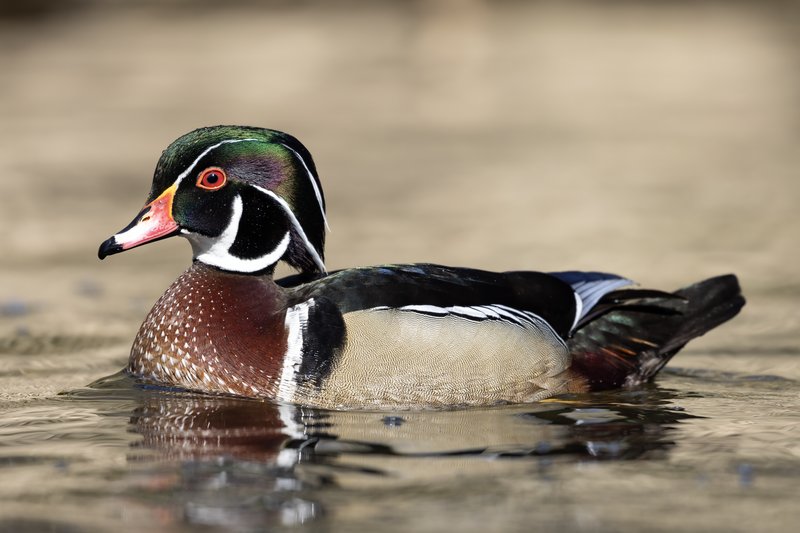
The Wood Duck is a medium-sized perching duck with a crested head. Males have multicolored iridescent plumage, red eyes, and a white neck flare, while females have a white eye-ring and whitish throat.
Where to find it
It breeds around wooded swamps, shallow lakes, marshes, ponds, and creeks in parts of the United States, southern Canada, and western Mexico. Wood Ducks perch and nest in tree cavities near water, and they dabble or graze for berries, acorns, seeds, and insects.
BirdBrain regions that include this bird
- California
- Eastern Canada
- Eastern Europe
- Florida
- Great Lakes
- Mexico
- Mid-Atlantic
- New England
- Northwest
- Plains
- Rocky Mountains
- Southeast
- Southwest
- Texas
- Western Canada
- Western Europe
Did you know?
- Wood Ducks are among the few duck species that perch and nest in trees.
- In southern regions, they can produce two broods in a single season.
- Ducklings may jump from nest cavities as high as 50 feet and survive the fall.
Learn the Wood Duck by ear
BirdBrain Academy teaches bird sounds with side-by-side listening and quizzes that use different recordings, so you learn the bird rather than one clip. Start with six free lessons, no signup needed. On your phone, Sound ID can name the birds singing around you.
Related birds
 Blue-winged TealWaterfowl
 Canada GooseWaterfowl
 GadwallWaterfowl
 Hooded MerganserWaterfowl
 MallardWaterfowl
 Northern PintailWaterfowl
Species notes are adapted from Wikipedia, available under CC BY-SA 4.0, and checked for BirdBrain. Recordings come from xeno-canto under the licenses shown with each one. Photo: Chuck Homler d/b/a FocusOnwWildlife, CC BY-SA 4.0, via Wikimedia Commons. Identification guidance is educational; birds vary, so confirm unusual sightings with local experts or eBird.