 BirdBrain Academy
Waterfowl · Anatidae
Blue-winged Teal sounds
Spatula discors
The Blue-winged Teal is a small North American dabbling duck that breeds widely and winters along coasts and farther south.
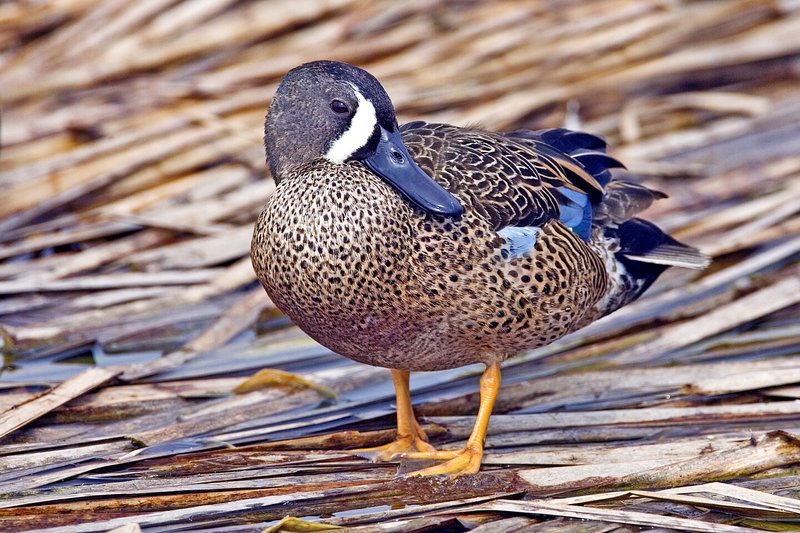

Listen to the Blue-winged Teal
Each recording below is a short excerpt with its spectrogram, a picture of the sound. Time runs left to right and higher pitches sit higher up. Play each one, then look for the same shape in the next. Different recordings of the same bird help you learn the bird, not one clip.

Recorded by Jonathon Jongsma, Murphy-Hanrehan Park Reserve, Dakota, Minnesota, 2014-05-25. XC179673 on xeno-canto, CC BY-SA 4.0. Five-second excerpt.

Recorded by Jonathon Jongsma, Powderhorn Park, Minneapolis, Hennepin, Minnesota, 2012-05-06. XC101288 on xeno-canto, CC BY-SA 3.0. Five-second excerpt.

Recorded by Jonathon Jongsma, Murphy-Hanrehan Park Reserve, Dakota, Minnesota, 2014-05-25. XC179673 on xeno-canto, CC BY-SA 4.0. Five-second excerpt.
What to listen for
The male gives a short whistle, while the female gives a soft quack.
What it looks like
The Blue-winged Teal is about 40 cm long, with a 58 cm wingspan and a weight around 370 g. Males have a greyish blue head with a white facial crescent, while females are mottled brown with a whitish area at the bill base; both sexes show sky-blue wing coverts, a green speculum, and yellow legs.
Where to find it
It breeds around marshes and ponds, inhabiting calm shorelines, inland marshes, lakes, shallow streams, and wetlands with dense emergent vegetation. The Blue-winged Teal feeds by dabbling in shallow water at marsh edges or open water, mainly eating plants with some molluscs and aquatic insects.
BirdBrain regions that include this bird
- Alaska
- Amazon Basin
- Andean Region
- California
- Caribbean
- Central America
- Eastern Canada
- Florida
- Great Lakes
- Mexico
- Mid-Atlantic
- New England
- Northern South America
- Northwest
- Plains
- Polynesia
- Southeast
- Texas
- Western Canada
Did you know?
- Blue-winged Teal are generally the first ducks south in fall and the last ones north in spring.
- During migration, some may fly long distances over open ocean.
- It is the most abundant duck in the mixed-grass prairies of the Dakotas and prairie provinces of Canada.
Learn the Blue-winged Teal by ear
BirdBrain Academy teaches bird sounds with side-by-side listening and quizzes that use different recordings, so you learn the bird rather than one clip. Start with six free lessons, no signup needed. On your phone, Sound ID can name the birds singing around you.
Related birds
 Canada GooseWaterfowl
 GadwallWaterfowl
 Hooded MerganserWaterfowl
 MallardWaterfowl
 Northern PintailWaterfowl
 Northern ShovelerWaterfowl
Species notes are adapted from Wikipedia, available under CC BY-SA 4.0, and checked for BirdBrain. Recordings come from xeno-canto under the licenses shown with each one. Photo: Alan D. Wilson, www.naturespicsonline.com, CC BY-SA 2.5, via Wikimedia Commons. Identification guidance is educational; birds vary, so confirm unusual sightings with local experts or eBird.