 BirdBrain Academy
Waterfowl · Anatidae
Northern Shoveler sounds
Spatula clypeata
The Northern Shoveler is a common, widespread duck breeding across northern Eurasia and North America and wintering far to the south.
Listen to the Northern Shoveler
Each recording below is a short excerpt with its spectrogram, a picture of the sound. Time runs left to right and higher pitches sit higher up. Play each one, then look for the same shape in the next. Different recordings of the same bird help you learn the bird, not one clip.

Recorded by Sonothèque ADVL, Pontorson, Manche, Normandie, 2024-03-21. XC919310 on xeno-canto, CC0 1.0. Five-second excerpt.



What to listen for
The Northern Shoveler is fairly quiet; the male gives a clunking call, while the female has a Mallard-like quack.
What it looks like
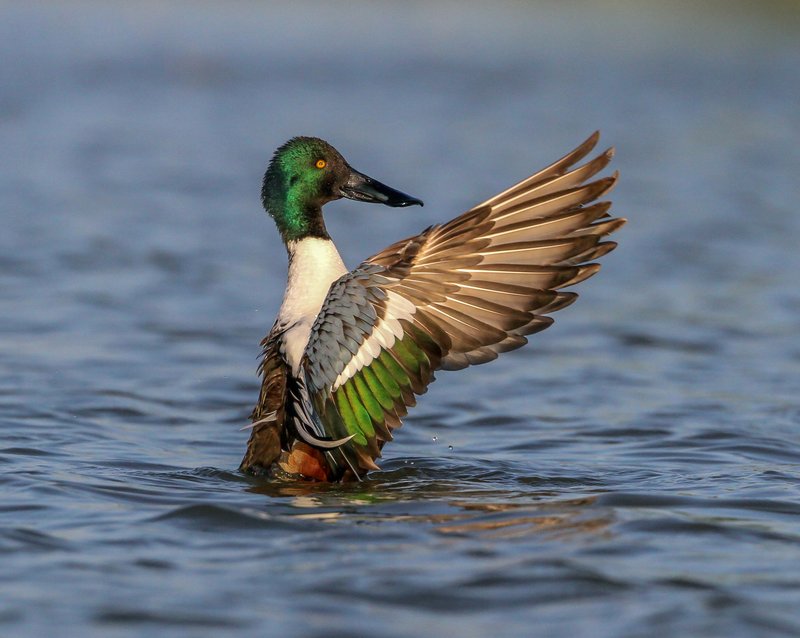
It is unmistakable in the northern hemisphere for its large spatulate bill. Breeding males have a dark green head, white breast, chestnut belly and flanks, while females are dull mottled brown with a long broad bill.
Where to find it
The Northern Shoveler lives in open wetlands such as wet grasslands and marshes with emergent vegetation, favoring mud-bottomed marshes rich in invertebrates. It feeds by dabbling, sweeping its bill side to side and sometimes swimming in circles with others to gather food at the surface.
BirdBrain regions that include this bird
- Alaska
- California
- Central Asia
- Central Russia
- East Asia
- Eastern Africa
- Eastern Canada
- Eastern Europe
- Eastern Russia
- Florida
- Great Lakes
- Mexico
- Mid-Atlantic
- New England
- Northern Europe
- Plains
- Polynesia
- Rocky Mountains
- South Asia
- Southeast
- Southern Europe
- Southwest
- Texas
- Western Canada
- Western Europe
- Western Russia
Did you know?
- Groups swim rapidly in circles, creating a funnel effect that gathers food at the water’s surface.
- Its wide bill has comb-like lamellae that sieve crustaceans and plankton from the water.
- Some wintering birds in the Indian Subcontinent cross the Himalayas, pausing in wetlands before continuing south.
Learn the Northern Shoveler by ear
BirdBrain Academy teaches bird sounds with side-by-side listening and quizzes that use different recordings, so you learn the bird rather than one clip. Start with six free lessons, no signup needed. On your phone, Sound ID can name the birds singing around you.
Related birds
 Blue-winged TealWaterfowl
 Canada GooseWaterfowl
 GadwallWaterfowl
 Hooded MerganserWaterfowl
 MallardWaterfowl
 Northern PintailWaterfowl
Species notes are adapted from Wikipedia, available under CC BY-SA 4.0, and checked for BirdBrain. Recordings come from xeno-canto under the licenses shown with each one. Photo: U.S. Fish and Wildlife Service Headquarters, Public domain, via Wikimedia Commons. Identification guidance is educational; birds vary, so confirm unusual sightings with local experts or eBird.