 BirdBrain Academy
Waterfowl · Anatidae
Tundra Swan sounds
Cygnus columbianus
The Tundra Swan is a small swan of the Holarctic, known as Bewick's swan or whistling swan by subspecies.

Listen to the Tundra Swan
Each recording below is a short excerpt with its spectrogram, a picture of the sound. Time runs left to right and higher pitches sit higher up. Play each one, then look for the same shape in the next. Different recordings of the same bird help you learn the bird, not one clip.

Recorded by steve, Sixth Siding, Beaufort County, North Carolina, 2025-02-07. XC972031 on xeno-canto, CC BY-SA 4.0. Five-second excerpt.

Recorded by steve, Sixth Siding, Beaufort County, North Carolina, 2025-02-07. XC972031 on xeno-canto, CC BY-SA 4.0. Five-second excerpt.

Recorded by steve, Sixth Siding, Beaufort County, North Carolina, 2025-02-07. XC972031 on xeno-canto, CC BY-SA 4.0. Five-second excerpt.
What to listen for
The Tundra Swan has high-pitched honking calls, similar to a black goose. On wintering grounds, flocks become especially vocal when foraging, and arrivals or departures stir loud excited calling.
Many listeners write its call as “bow-wow...”. Treat a written sound as a memory aid; individual birds and regions vary.
When you are most likely to hear it: Especially when foraging in flocks on wintering grounds.
What it looks like
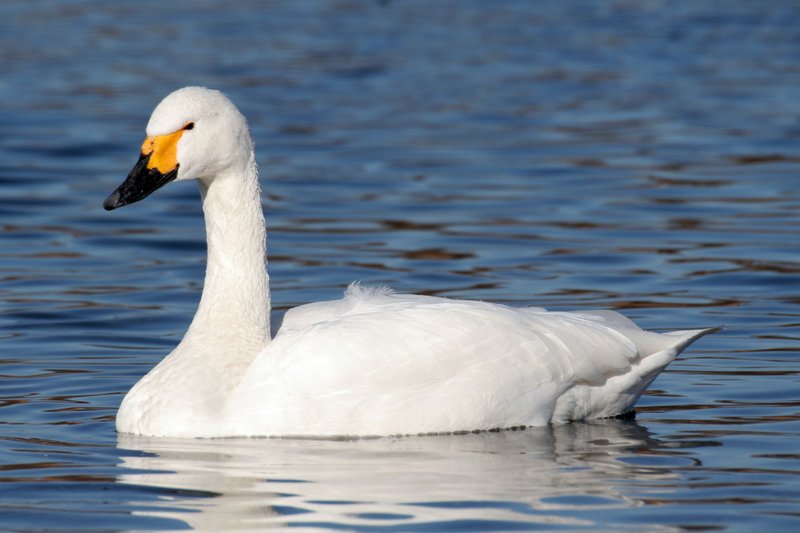
The Tundra Swan is the smallest Holarctic swan, with entirely white adult plumage, black feet, and a mostly black bill marked by a thin salmon-pink mouthline and variable yellow near the base. Iron-rich waters may stain the head and neck golden or rusty.
Where to find it
It breeds in Arctic and subarctic tundra, inhabiting shallow pools, lakes, and rivers, then migrates to winter grasslands and marshlands, often near coasts. During migration it may stop on mountain lakes and visits harvested fields for discarded grain.
BirdBrain regions that include this bird
- Alaska
- Arctic
- California
- East Asia
- Eastern Canada
- Eastern Europe
- Florida
- Great Lakes
- Mid-Atlantic
- New England
- Northern Europe
- Northwest
- Plains
- Southeast
- Southern Europe
- Texas
- Western Canada
- Western Europe
Did you know?
- Each Bewick's swan has a unique bill pattern, used by scientists to identify individuals.
- Some migrating Tundra Swans can fly at altitudes of 8 km in a V formation.
Learn the Tundra Swan by ear
BirdBrain Academy teaches bird sounds with side-by-side listening and quizzes that use different recordings, so you learn the bird rather than one clip. Start with six free lessons, no signup needed. On your phone, Sound ID can name the birds singing around you.
Related birds
 Blue-winged TealWaterfowl
 Canada GooseWaterfowl
 GadwallWaterfowl
 Hooded MerganserWaterfowl
 MallardWaterfowl
 Northern PintailWaterfowl
Species notes are adapted from Wikipedia, available under CC BY-SA 4.0, and checked for BirdBrain. Recordings come from xeno-canto under the licenses shown with each one. Photo: Maga-chan, CC BY-SA 2.5, via Wikimedia Commons. Identification guidance is educational; birds vary, so confirm unusual sightings with local experts or eBird.