 BirdBrain Academy
Shorebirds · Scolopacidae
Lesser Yellowlegs sounds
Tringa flavipes
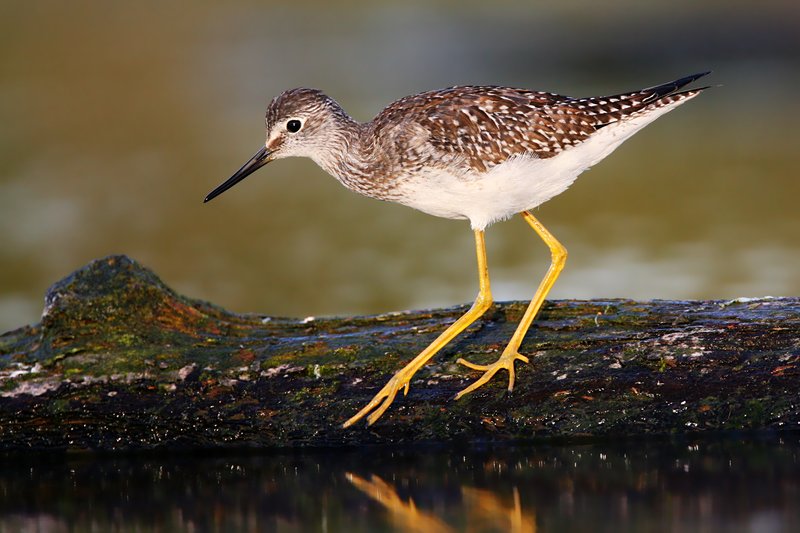
The Lesser Yellowlegs is a medium-sized shorebird that breeds in North America’s boreal forest region.

Listen to the Lesser Yellowlegs
Each recording below is a short excerpt with its spectrogram, a picture of the sound. Time runs left to right and higher pitches sit higher up. Play each one, then look for the same shape in the next. Different recordings of the same bird help you learn the bird, not one clip.

Recorded by Doug Hynes, Landing Lake, Churchill, MB, 2010-06-02. XC934273 on xeno-canto, CC BY-SA 4.0. Five-second excerpt.

Recorded by Doug Hynes, Landing Lake, Churchill, MB, 2010-06-02. XC934273 on xeno-canto, CC BY-SA 4.0. Five-second excerpt.

Recorded by Doug Hynes, Landing Lake, Churchill, MB, 2010-06-02. XC934273 on xeno-canto, CC BY-SA 4.0. Five-second excerpt.
What to listen for
What it looks like
The Lesser Yellowlegs is a medium-large shorebird, 23–25 cm long, with yellow legs and similar plumage in both sexes. Breeding birds are mottled gray-brown, black, and white above, with white underparts streaked brown on the breast and neck.
Where to find it
It breeds in clearings near ponds in boreal forest from Alaska to Quebec, with its range centered in northern wetland habitats. It forages actively in shallow water or on land, moving quickly with a high-stepping gait and picking prey with quick jabs of the bill.
BirdBrain regions that include this bird
- Alaska
- Amazon Basin
- Andean Region
- California
- Caribbean
- Central America
- Eastern Canada
- Eastern Europe
- Eastern South America
- Florida
- Great Lakes
- Mexico
- Mid-Atlantic
- New England
- Northern South America
- Northwest
- Plains
- Polynesia
- Rocky Mountains
- Southeast
- Southern Europe
- Southern South America
- Southwest
- Texas
- Western Canada
- Western Europe
Did you know?
- The Lesser Yellowlegs is highly migratory.
- About five birds arrive in Great Britain each year, mostly between August and October.
- It sometimes forages at night.
Learn the Lesser Yellowlegs by ear
BirdBrain Academy teaches bird sounds with side-by-side listening and quizzes that use different recordings, so you learn the bird rather than one clip. Start with six free lessons, no signup needed. On your phone, Sound ID can name the birds singing around you.
Related birds
 American AvocetShorebirds
 Black-necked StiltShorebirds
 Greater YellowlegsShorebirds
 Wilson's SnipeShorebirds
Species notes are adapted from Wikipedia, available under CC BY-SA 4.0, and checked for BirdBrain. Recordings come from xeno-canto under the licenses shown with each one. Photo: Wwcsig, CC BY-SA 3.0, via Wikimedia Commons. Identification guidance is educational; birds vary, so confirm unusual sightings with local experts or eBird.