 BirdBrain Academy
Shorebirds · Recurvirostridae
Black-necked Stilt sounds
Himantopus mexicanus
The Black-necked Stilt is a locally abundant shorebird of American wetlands and coastlines, with northern populations that migrate south in winter.

Listen to the Black-necked Stilt
Each recording below is a short excerpt with its spectrogram, a picture of the sound. Time runs left to right and higher pitches sit higher up. Play each one, then look for the same shape in the next. Different recordings of the same bird help you learn the bird, not one clip.

Recorded by Jonathon Jongsma, Palo Alto Baylands, Santa Clara, California, 2012-04-21. XC99570 on xeno-canto, CC BY-SA 3.0. Five-second excerpt.

Recorded by Jonathon Jongsma, Palo Alto Baylands, Santa Clara, California, 2012-04-21. XC133081 on xeno-canto, CC BY-SA 3.0. Five-second excerpt.

Recorded by Jonathon Jongsma, Palo Alto Baylands, Santa Clara, California, 2012-04-21. XC99570 on xeno-canto, CC BY-SA 3.0. Five-second excerpt.
What to listen for
What it looks like
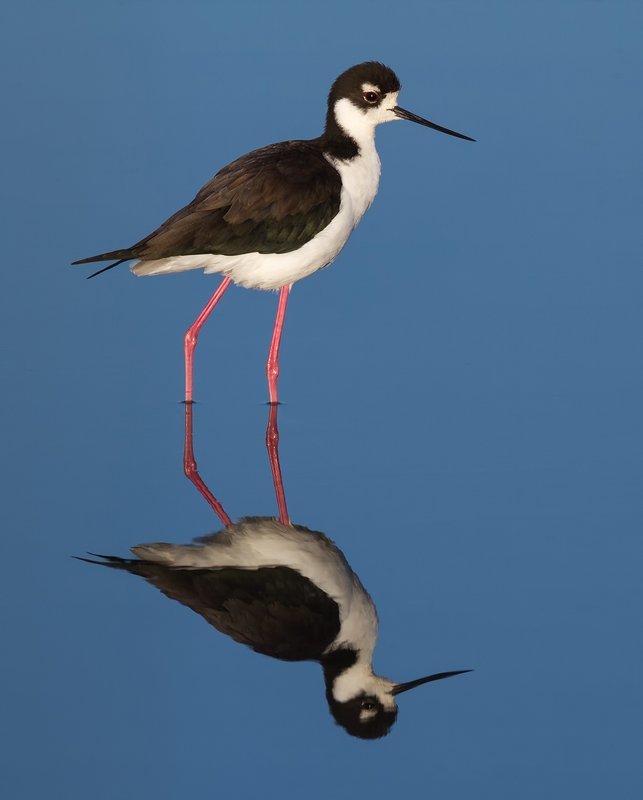
The Black-necked Stilt has long pink legs, a long thin black bill, white underparts, and black wings and back. A black band runs up the hind neck to a head cap, with a small white spot above the eye.
Where to find it
It lives in estuarine, lake, salt pond, and emergent wetland habitats, favoring shallow saline wetlands, mudflats, lakeshores, alkali flats, and flooded fields. It forages by probing and gleaning in mudflats, lakeshores, and very shallow water.
BirdBrain regions that include this bird
- Andean Region
- California
- Caribbean
- Central America
- Eastern South America
- Florida
- Mexico
- Mid-Atlantic
- Northern South America
- Plains
- Polynesia
- Southeast
- Southern South America
- Southwest
- Texas
- Western Canada
Did you know?
- Downy young can be seen swimming within two hours after hatching.
- The left eye is used to identify predators, competitors, and mates; the right eye helps locate prey.
- Pairs defend broad perimeters around grouped nests, often patrolling with neighboring pairs.
Learn the Black-necked Stilt by ear
BirdBrain Academy teaches bird sounds with side-by-side listening and quizzes that use different recordings, so you learn the bird rather than one clip. Start with six free lessons, no signup needed. On your phone, Sound ID can name the birds singing around you.
Related birds
 American AvocetShorebirds
 Greater YellowlegsShorebirds
 Lesser YellowlegsShorebirds
 Wilson's SnipeShorebirds
Species notes are adapted from Wikipedia, available under CC BY-SA 4.0, and checked for BirdBrain. Recordings come from xeno-canto under the licenses shown with each one. Photo: Frank Schulenburg, CC BY-SA 3.0, via Wikimedia Commons. Identification guidance is educational; birds vary, so confirm unusual sightings with local experts or eBird.