 BirdBrain Academy
Blackbirds and Orioles · Icteridae
Common Grackle sounds
Quiscalus quiscula
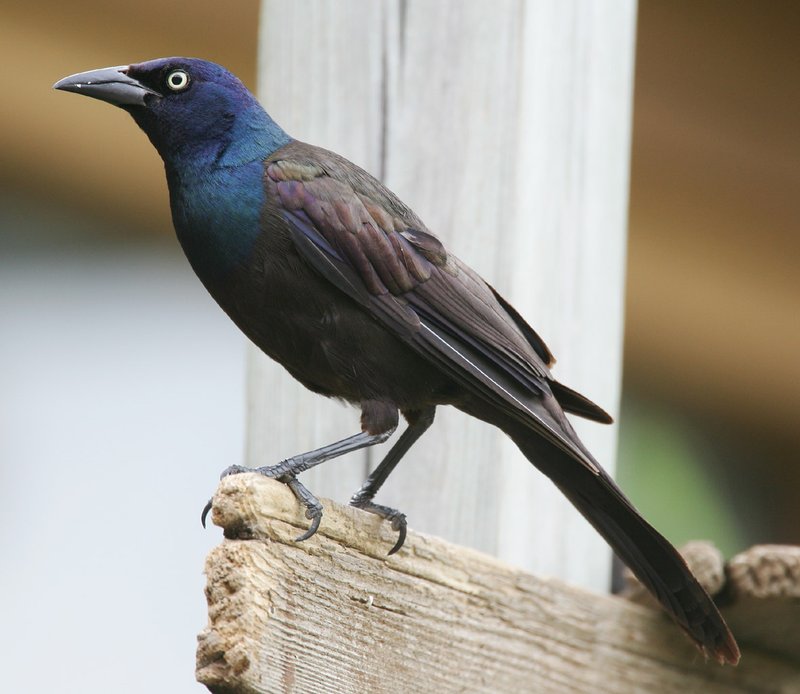
The Common Grackle is an adaptable North American icterid with a long dark bill, pale eyes, long tail, and iridescent head.

Listen to the Common Grackle
Each recording below is a short excerpt with its spectrogram, a picture of the sound. Time runs left to right and higher pitches sit higher up. Play each one, then look for the same shape in the next. Different recordings of the same bird help you learn the bird, not one clip.

Recorded by steve, Buffalo City, Dare County, North Carolina, 2025-02-07. XC972030 on xeno-canto, CC BY-SA 4.0. Five-second excerpt.

Recorded by steve, Wenona, Washington County, North Carolina, 2024-02-03. XC871145 on xeno-canto, CC BY-SA 4.0. Five-second excerpt.

Recorded by Jonathon Jongsma, Sioux Center, Sioux, Iowa, 2013-04-19. XC131090 on xeno-canto, CC BY-SA 3.0. Five-second excerpt.
What to listen for
Its voice is harsh, especially when flocks are calling. Songs range from a year-round phrase to a faster breeding-season call ending loudly, and it may also buzz like a power line.
Many listeners write its call as “chewink chewink”. Treat a written sound as a memory aid; individual birds and regions vary.
When you are most likely to hear it: Year-round, with a more complex call in the breeding season.
What it looks like
Adults are 28 to 34 cm long, with long dark bills, pale yellowish eyes, and long tails. Their feathers look black with purple, green, or blue iridescence on the head and a bronze sheen on the body; females are smaller and less iridescent, and juveniles are brown with dark brown eyes.
Where to find it
The Common Grackle breeds in open and semiopen areas across North America east of the Rocky Mountains, often nesting near water in dense trees, shrubs, cavities, man-made structures, or colonies. It forages on the ground, in shallow water, or in shrubs, eating widely and sometimes stealing food from other birds.
BirdBrain regions that include this bird
- Alaska
- California
- Caribbean
- Eastern Canada
- Florida
- Great Lakes
- Mexico
- Mid-Atlantic
- New England
- Plains
- Rocky Mountains
- Southeast
- Southwest
- Texas
- Western Canada
Did you know?
- When grackles gather in a group, they are called a "plague".
- The Common Grackle may practice anting, rubbing insects on its feathers.
- It can mimic other birds or even humans, though less precisely than a mockingbird.
Learn the Common Grackle by ear
BirdBrain Academy teaches bird sounds with side-by-side listening and quizzes that use different recordings, so you learn the bird rather than one clip. Start with six free lessons, no signup needed. On your phone, Sound ID can name the birds singing around you.
Related birds
 Baltimore OrioleBlackbirds and Orioles
 Brown-headed CowbirdBlackbirds and Orioles
 Orchard OrioleBlackbirds and Orioles
 American AvocetShorebirds
 American CrowCorvids
 American GoldfinchFinches
Species notes are adapted from Wikipedia, available under CC BY-SA 4.0, and checked for BirdBrain. Recordings come from xeno-canto under the licenses shown with each one. Photo: Mdf, CC BY-SA 3.0, via Wikimedia Commons. Identification guidance is educational; birds vary, so confirm unusual sightings with local experts or eBird.