 BirdBrain Academy
Blackbirds and Orioles · Icteridae
Baltimore Oriole sounds
Icterus galbula
The Baltimore Oriole is a small migratory icterid blackbird common in eastern North America, known for the male’s Lord Baltimore colors.

Listen to the Baltimore Oriole
Each recording below is a short excerpt with its spectrogram, a picture of the sound. Time runs left to right and higher pitches sit higher up. Play each one, then look for the same shape in the next. Different recordings of the same bird help you learn the bird, not one clip.

Recorded by Jonathon Jongsma, Wild River State Park, Chisago County, Minnesota, 2014-05-10. XC178046 on xeno-canto, CC BY-SA 4.0. Five-second excerpt.

Recorded by Jonathon Jongsma, Grey Cloud Dunes SNA, Washington, Minnesota, 2013-05-25. XC134872 on xeno-canto, CC BY-SA 3.0. Five-second excerpt.

Recorded by Jonathon Jongsma, Wild River State Park, Chisago County, Minnesota, 2014-05-10. XC178046 on xeno-canto, CC BY-SA 4.0. Five-second excerpt.
What to listen for
Its song is a short set of recognizable, sweet whistles. Calls include an unusual nasal sound, low chatter, high calls, screeches near the nest, and warning chatter during confrontations.
Many listeners write its call as “tyew, pyeer, peededoo”. Treat a written sound as a memory aid; individual birds and regions vary.
What it looks like
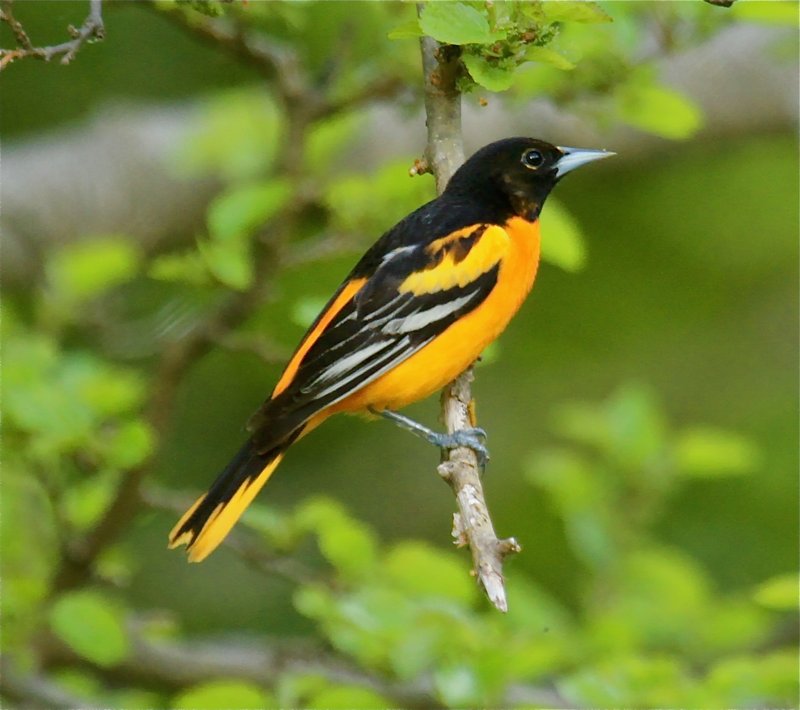
The Baltimore Oriole is a medium-sized passerine, 17–22 cm long, with a sturdy body, longish tail, fairly long legs, and a thick pointed bill. Adult males are orange below with black elsewhere, females are yellow-brown above with dull orange-yellow below, and adults always show white wing bars.
Where to find it
Baltimore Orioles breed across eastern North America and winter mainly in Central America and northern South America. They favor large leafy deciduous trees, open woodland, forest edges, wooded wetlands, orchards, farmland, parks, and suburbs, and they are basically solitary outside the mating season.
BirdBrain regions that include this bird
- Caribbean
- Central America
- Eastern Canada
- Florida
- Great Lakes
- Mexico
- Mid-Atlantic
- New England
- Northern South America
- Plains
- Polynesia
- Rocky Mountains
- Southeast
- Texas
- Western Canada
Did you know?
- The male’s colors resemble the coat-of-arms of 17th-century Lord Baltimore.
- The Baltimore Oriole is Maryland’s state bird and the namesake and mascot of the Baltimore Orioles baseball team.
- The oldest recorded wild Baltimore Oriole lived 11 years and 7 months.
Learn the Baltimore Oriole by ear
BirdBrain Academy teaches bird sounds with side-by-side listening and quizzes that use different recordings, so you learn the bird rather than one clip. Start with six free lessons, no signup needed. On your phone, Sound ID can name the birds singing around you.
Related birds
 Brown-headed CowbirdBlackbirds and Orioles
 Common GrackleBlackbirds and Orioles
 Orchard OrioleBlackbirds and Orioles
 American AvocetShorebirds
 American CrowCorvids
 American GoldfinchFinches
Species notes are adapted from Wikipedia, available under CC BY-SA 4.0, and checked for BirdBrain. Recordings come from xeno-canto under the licenses shown with each one. Photo: TonyCastro, CC BY-SA 4.0, via Wikimedia Commons. Identification guidance is educational; birds vary, so confirm unusual sightings with local experts or eBird.