 BirdBrain Academy
Wrens · Troglodytidae
Winter Wren sounds
Troglodytes hiemalis
A very small North American wren, the Winter Wren breeds in coniferous forests and winters across eastern North America.

Listen to the Winter Wren
Each recording below is a short excerpt with its spectrogram, a picture of the sound. Time runs left to right and higher pitches sit higher up. Play each one, then look for the same shape in the next. Different recordings of the same bird help you learn the bird, not one clip.

Recorded by Jonathon Jongsma, Miesville Ravine Park Reserve, Goodhue County, Minnesota, 2014-04-18. XC175234 on xeno-canto, CC BY-SA 4.0. Five-second excerpt.

Recorded by Doug Hynes, Seal Island, Nova Scotia, 2023-07-04. XC920776 on xeno-canto, CC BY-SA 4.0. Five-second excerpt.

Recorded by Jonathon Jongsma, Miesville Ravine Park Reserve, Goodhue County, Minnesota, 2014-04-18. XC175232 on xeno-canto, CC BY-SA 4.0. Five-second excerpt.
What to listen for
What it looks like
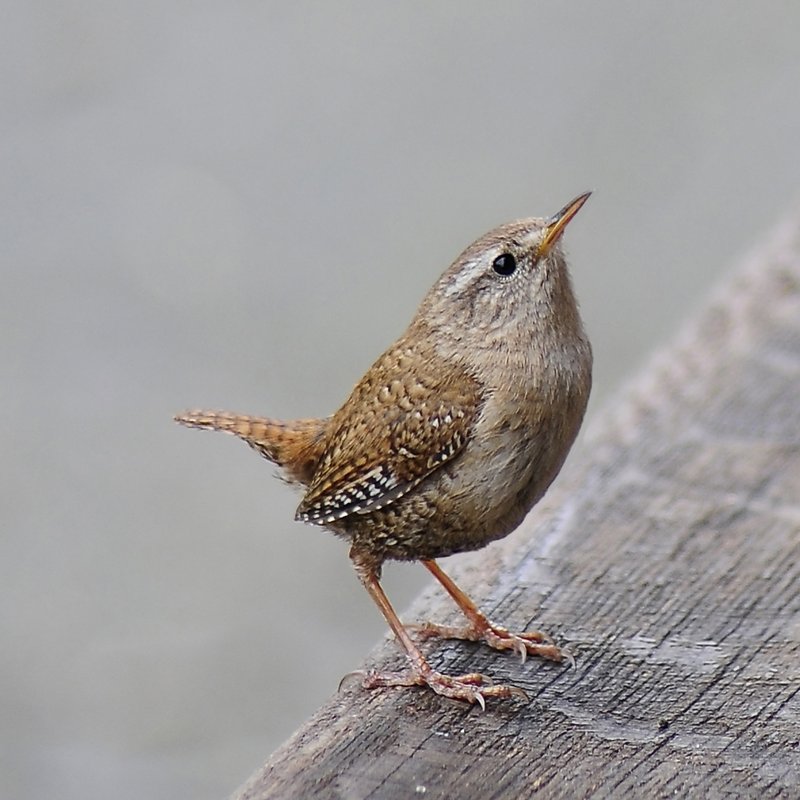
The Winter Wren is a tiny, round-looking brown bird with a short neck and a small tail often cocked above its back. It is rufous brown above, grayer below, barred darker brown and gray, and usually shows pale eyebrows over the eyes.
Where to find it
It nests mostly in coniferous forests, especially spruce and fir, and forages for insects on bark and fallen logs even in moderately cold or snowy conditions. Its movements are incessant as it creeps or climbs, with swift, direct short flights from bush to bush.
BirdBrain regions that include this bird
- Alaska
- California
- Eastern Canada
- Florida
- Great Lakes
- Mexico
- Mid-Atlantic
- Plains
- Southeast
- Southern Europe
- Southwest
- Texas
- Western Canada
- Western Europe
Did you know?
- At night in winter, it often roosts in dark retreats, snug holes, or old nests.
- In hard weather, several Winter Wrens may gather together for warmth.
- Its genus name means “cave-dweller,” referring to nesting in cavities or ground-gleaning in thick underbrush.
Learn the Winter Wren by ear
BirdBrain Academy teaches bird sounds with side-by-side listening and quizzes that use different recordings, so you learn the bird rather than one clip. Start with six free lessons, no signup needed. On your phone, Sound ID can name the birds singing around you.
Related birds
 House WrenWrens
 American AvocetShorebirds
 American CrowCorvids
 American GoldfinchFinches
 American KestrelFalcons
 American RobinThrushes
Species notes are adapted from Wikipedia, available under CC BY-SA 4.0, and checked for BirdBrain. Recordings come from xeno-canto under the licenses shown with each one. Photo: Joefrei, CC BY-SA 3.0, via Wikimedia Commons. Identification guidance is educational; birds vary, so confirm unusual sightings with local experts or eBird.