 BirdBrain Academy
Sparrows · Passerellidae
White-throated Sparrow sounds
Zonotrichia albicollis
The White-throated Sparrow is a New World sparrow that breeds in northern North America and winters in the southern United States.
Listen to the White-throated Sparrow
Each recording below is a short excerpt with its spectrogram, a picture of the sound. Time runs left to right and higher pitches sit higher up. Play each one, then look for the same shape in the next. Different recordings of the same bird help you learn the bird, not one clip.

Recorded by Doug Hynes, Pouch Cove Line, Newfoundland and Labrador, 2010-05-10. XC569523 on xeno-canto, CC BY-SA 4.0. Five-second excerpt.

Recorded by Jonathon Jongsma, Powderhorn Park, Minneapolis, Hennepin, Minnesota, 2014-05-07. XC177726 on xeno-canto, CC BY-SA 4.0. Five-second excerpt.

Recorded by Jonathon Jongsma, Gooseberry Falls State Park, Lake, Minnesota, 2013-06-15. XC138634 on xeno-canto, CC BY-SA 3.0. Five-second excerpt.
What to listen for
The White-throated Sparrow has at least two distinct songs, both built from an opening note followed by repeated notes. Its rhythm is very regular, with a pinched timbre, and the article notes at least two calls in addition to song.
Many listeners write its call as “Po-or Sam Peabody, Peabody, Peabody”. Treat a written sound as a memory aid; individual birds and regions vary.
A common memory phrase is “Po-or Sam Peabody, Peabody, Peabody”.
What it looks like
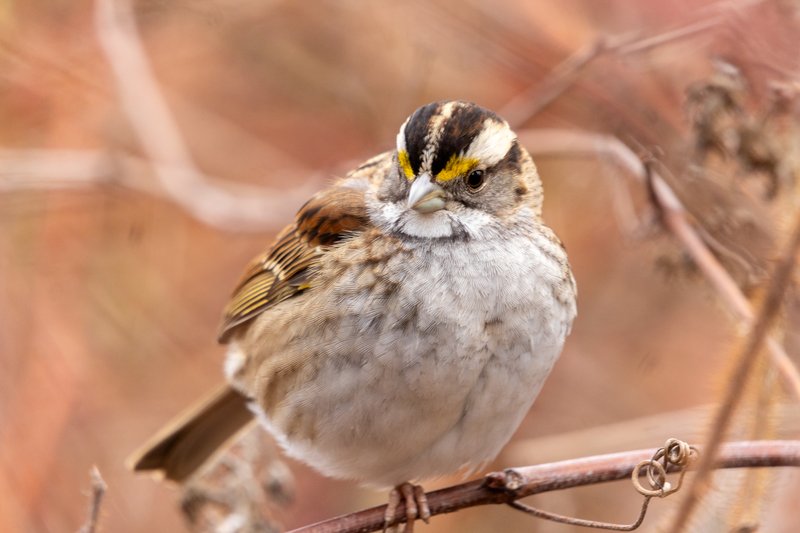
The White-throated Sparrow measures 15 to 19 cm long, with a 23 cm wingspan and typical weight of 22 to 32 g. It has a white throat, yellow lores, a gray bill, two white wing bars, and either white-striped or tan-striped head forms.
Where to find it
It breeds in central Canada and New England, nesting on the ground under shrubs or low in trees in deciduous or mixed forest areas. In winter it migrates to the southern and eastern United States, while foraging on the ground under or near thickets or low vegetation.
BirdBrain regions that include this bird
- Alaska
- California
- Eastern Canada
- Florida
- Great Lakes
- Mexico
- Mid-Atlantic
- New England
- Northwest
- Plains
- Rocky Mountains
- Southern Europe
- Southwest
- Texas
- Western Canada
- Western Europe
Did you know?
- Tan and white morphs use different reproductive strategies and usually pair with the opposite color morph.
- White-striped birds are more aggressive than tan-striped birds during the breeding season.
- A new song pattern appeared in British Columbia and then spread east.
Learn the White-throated Sparrow by ear
BirdBrain Academy teaches bird sounds with side-by-side listening and quizzes that use different recordings, so you learn the bird rather than one clip. Start with six free lessons, no signup needed. On your phone, Sound ID can name the birds singing around you.
Related birds


Species notes are adapted from Wikipedia, available under CC BY-SA 4.0, and checked for BirdBrain. Recordings come from xeno-canto under the licenses shown with each one. Photo: CBBrit25, CC BY 4.0, via Wikimedia Commons. Identification guidance is educational; birds vary, so confirm unusual sightings with local experts or eBird.