 BirdBrain Academy
Thrushes · Turdidae
Western Bluebird sounds
Sialia mexicana
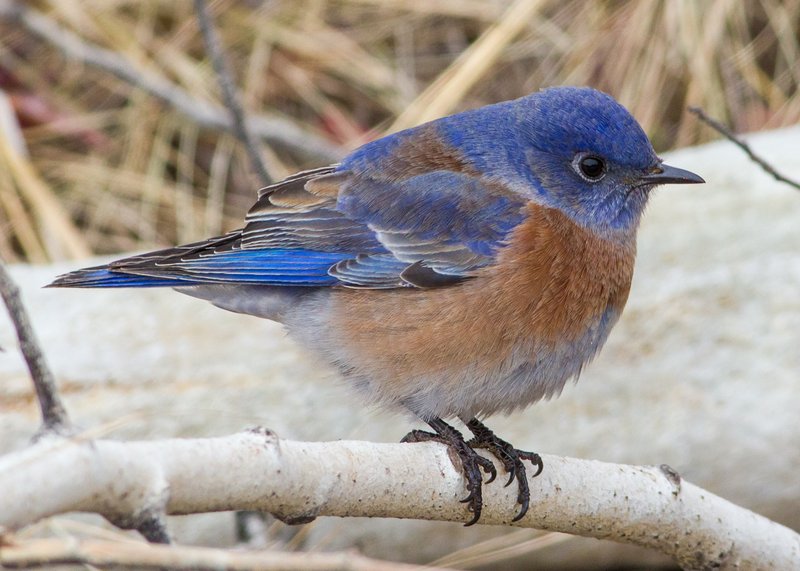
The Western Bluebird is a small North American thrush with blue plumage and warm orange tones.

Listen to the Western Bluebird
Each recording below is a short excerpt with its spectrogram, a picture of the sound. Time runs left to right and higher pitches sit higher up. Play each one, then look for the same shape in the next. Different recordings of the same bird help you learn the bird, not one clip.

Recorded by Ryan Winkleman, Rancho Santa Margarita, Orange County, California, 2016-06-17. XC322143 on xeno-canto, CC BY-SA 4.0. Five-second excerpt.

Recorded by Ryan Winkleman, Rancho Santa Margarita, Orange County, California, 2016-06-15. XC321718 on xeno-canto, CC BY-SA 4.0. Five-second excerpt.

Recorded by Ryan Winkleman, Rancho Santa Margarita, Orange County, California, 2016-06-17. XC322143 on xeno-canto, CC BY-SA 4.0. Five-second excerpt.
What to listen for
Its mating songs sound like soft, simple notes, helping males find females in dense forest and mark territory against rivals.
Many listeners write its call as “cheer”. Treat a written sound as a memory aid; individual birds and regions vary.
What it looks like
The Western Bluebird is a small, stocky bird, 15 to 18 cm long, with a thin straight bill and a fairly short tail. Adult males are bright blue above and on the throat with an orange breast and sides, while females are duller blue with a gray throat and dull orange breast.
Where to find it
The Western Bluebird has adapted to coniferous forests, farmlands, semi-open terrain, and desert after displacement from natural habitat by tree felling. It nests in cavities or nest boxes and forages by pouncing to the ground or flying out from a perch to catch insects.
BirdBrain regions that include this bird
- California
- Mexico
- Northwest
- Polynesia
- Texas
- Western Canada
Did you know?
- Western Bluebirds rely on woodpeckers to make nest holes because their beaks are too weak to dig their own.
- In genetic studies, 45% of nests carried young not fathered by the male partner.
- After their own nest fails, they may help their parents raise a new brood.
Learn the Western Bluebird by ear
BirdBrain Academy teaches bird sounds with side-by-side listening and quizzes that use different recordings, so you learn the bird rather than one clip. Start with six free lessons, no signup needed. On your phone, Sound ID can name the birds singing around you.
Related birds
 American RobinThrushes
 Eastern BluebirdThrushes
 American AvocetShorebirds
 American CrowCorvids
 American GoldfinchFinches
 American KestrelFalcons
Species notes are adapted from Wikipedia, available under CC BY-SA 4.0, and checked for BirdBrain. Recordings come from xeno-canto under the licenses shown with each one. Photo: Blalonde, CC BY-SA 4.0, via Wikimedia Commons. Identification guidance is educational; birds vary, so confirm unusual sightings with local experts or eBird.