 BirdBrain Academy
Uncategorized ·
Red-breasted Merganser sounds
Mergus serrator
A swift, diving Northern Hemisphere duck, the Red-breasted Merganser pursues aquatic prey underwater with its serrated red bill.

Listen to the Red-breasted Merganser
Each recording below is a short excerpt with its spectrogram, a picture of the sound. Time runs left to right and higher pitches sit higher up. Play each one, then look for the same shape in the next. Different recordings of the same bird help you learn the bird, not one clip.

Recorded by Jochem verweij, Mörbylånga Municipality, Kalmar län, 2024-04-24. XC898199 on xeno-canto, CC BY-SA 4.0. Five-second excerpt.
What to listen for
During courtship, the female gives a rasping prrak prrak, while the male gives a catlike meow. In flight, the female makes a harsh gruk; at other times, the species is largely silent.
Many listeners write its call as “prrak prrak”. Treat a written sound as a memory aid; individual birds and regions vary.
When you are most likely to hear it: During courtship; otherwise largely silent..
What it looks like
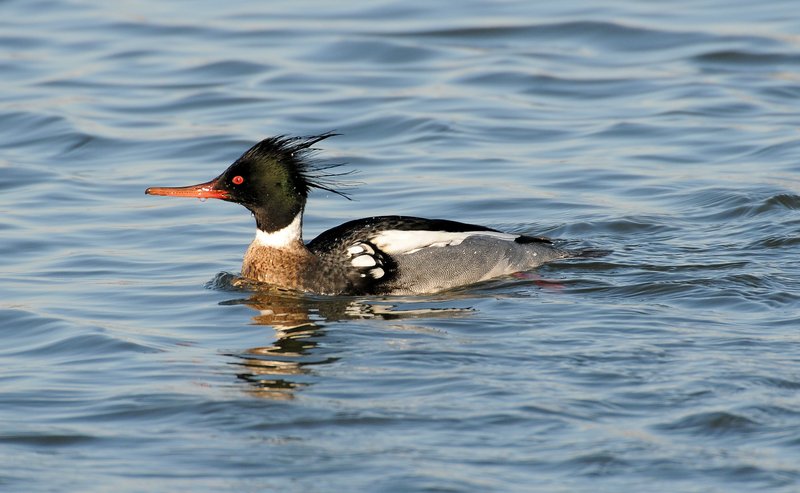
The Red-breasted Merganser is 51–64 cm long, with a 66–74 cm wingspan, a spiky crest, and a long, thin red bill with serrated edges. Males have a dark green-sheened head, white neck, rusty breast, black back, and white underparts; females have a rusty head and greyish-brown body.
Where to find it
It breeds on freshwater lakes and rivers across northern North America, Greenland, Europe, and the Palearctic, nesting in sheltered places on the ground near water. Mostly migratory, northern breeders winter farther south in coastal waters, diving and swimming underwater for small fish and other aquatic prey.
BirdBrain regions that include this bird
- Alaska
- California
- Central Russia
- Eastern Canada
- Eastern Europe
- Eastern Russia
- Florida
- Great Lakes
- Mid-Atlantic
- New England
- Northern Europe
- Northwest
- Rocky Mountains
- Southeast
- Southwest
- Texas
- Western Canada
- Western Europe
- Western Russia
Did you know?
- Its serrated bill helps it hold slippery fish.
- Males perform synchronized courtship displays while swimming.
- It is the Mergus species most often found regularly in saltwater.
Learn the Red-breasted Merganser by ear
BirdBrain Academy teaches bird sounds with side-by-side listening and quizzes that use different recordings, so you learn the bird rather than one clip. Start with six free lessons, no signup needed. On your phone, Sound ID can name the birds singing around you.
Related birds
 Cooper's HawkUncategorized
 Fish CrowUncategorized
 Great EgretUncategorized
 American AvocetShorebirds
 American CrowCorvids
 American GoldfinchFinches
Species notes are adapted from Wikipedia, available under CC BY-SA 4.0, and checked for BirdBrain. Recordings come from xeno-canto under the licenses shown with each one. Photo: Peter Massas, CC BY-SA 2.0, via Wikimedia Commons. Identification guidance is educational; birds vary, so confirm unusual sightings with local experts or eBird.