 BirdBrain Academy
Rails and Coots · Rallidae
Purple Gallinule sounds
Porphyrio martinicus
The Purple Gallinule is a rail-like swamphen of the Americas, also known locally as the yellow-legged gallinule.
Listen to the Purple Gallinule
Each recording below is a short excerpt with its spectrogram, a picture of the sound. Time runs left to right and higher pitches sit higher up. Play each one, then look for the same shape in the next. Different recordings of the same bird help you learn the bird, not one clip.


What to listen for
What it looks like
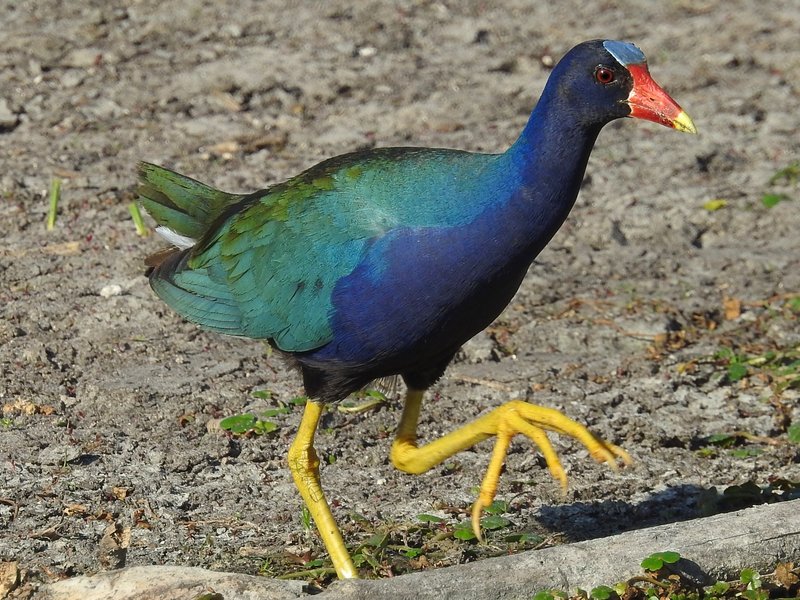
The Purple Gallinule is a medium-sized rail with purple-blue plumage that can shine green and turquoise in good light. Adults have a pale blue forehead shield, a red and yellow bill, long toes, and bright yellow legs and feet.
Where to find it
It lives in freshwater marshes with dense stands of vegetation, ranging through the southeastern United States, southern Florida, Mexico, Central America, the Caribbean, and parts of South America. It feeds on the ground, walks on floating vegetation with its long toes, and usually flies only short distances.
BirdBrain regions that include this bird
- Amazon Basin
- Andean Region
- Caribbean
- Central America
- Eastern South America
- Florida
- Mexico
- New England
- Northern South America
- Polynesia
- Southeast
- Southern South America
- Southwest
- Texas
Did you know?
- Its long toes spread its weight across floating vegetation.
- The species has the greatest pattern of vagrancy among rails.
- Juveniles may remain in the territory to help care for siblings.
Learn the Purple Gallinule by ear
BirdBrain Academy teaches bird sounds with side-by-side listening and quizzes that use different recordings, so you learn the bird rather than one clip. Start with six free lessons, no signup needed. On your phone, Sound ID can name the birds singing around you.
Related birds
 American AvocetShorebirds
 American CrowCorvids
 American GoldfinchFinches
 American KestrelFalcons
 American RobinThrushes
 American Tree SparrowSparrows
Species notes are adapted from Wikipedia, available under CC BY-SA 4.0, and checked for BirdBrain. Recordings come from xeno-canto under the licenses shown with each one. Photo: JeffreyGammon, CC BY 4.0, via Wikimedia Commons. Identification guidance is educational; birds vary, so confirm unusual sightings with local experts or eBird.