 BirdBrain Academy
Old World Sparrows · Passeridae
House Sparrow sounds
Passer domesticus
A small, human-associated sparrow of towns and countryside, the House Sparrow is among the world's most widely distributed wild birds.
Listen to the House Sparrow
Each recording below is a short excerpt with its spectrogram, a picture of the sound. Time runs left to right and higher pitches sit higher up. Play each one, then look for the same shape in the next. Different recordings of the same bird help you learn the bird, not one clip.



What to listen for
Most vocalizations are short, frequent chirping calls, used by flocking or resting birds and by males near nest sites. In breeding season, males repeat the call with speed and emphasis into a song-like ecstatic call, while alarm and appeasement calls are also described.
Many listeners write its call as “chirrup”. Treat a written sound as a memory aid; individual birds and regions vary.
When you are most likely to hear it: In the breeding season, and around communal roosts in the evening and morning..
What it looks like
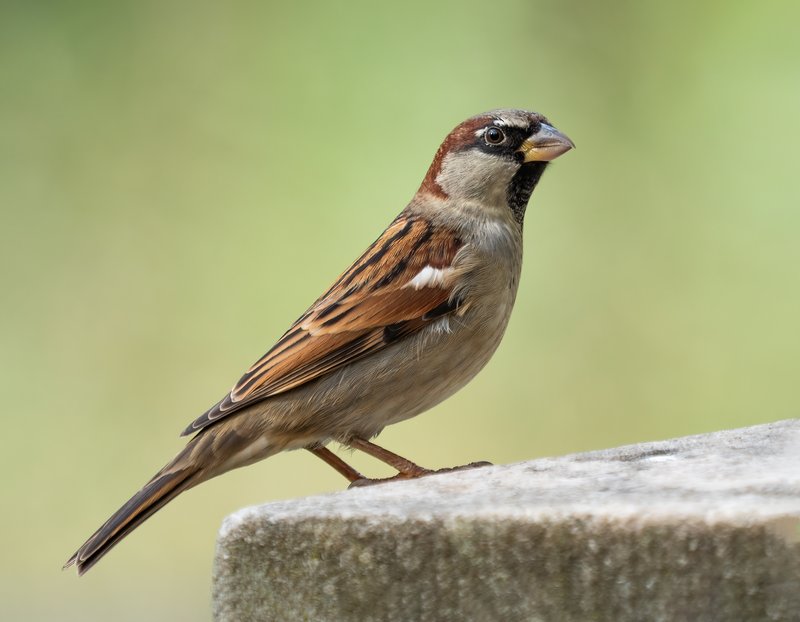
The House Sparrow is a compact bird about 16 cm long, with a full chest, rounded head, stout conical bill, and mostly grey-brown plumage. Females are buffish brown and grey, while males show bold head markings, a reddish back, grey underparts, and a black throat and chest bib.
Where to find it
The House Sparrow is closely tied to human habitation and cultivation, living in urban and rural settings while generally avoiding dense forest and tundra. It is highly social, feeding in flocks, roosting communally, and often bathing or calling together in bushes.
BirdBrain regions that include this bird
- Amazon Basin
- Andean Region
- Arctic
- Australia
- California
- Caribbean
- Central Africa
- Central America
- Central Asia
- Central Russia
- East Asia
- Eastern Africa
- Eastern Canada
- Eastern Europe
- Eastern Russia
- Eastern South America
- Florida
- Great Lakes
- Indian Ocean Islands
- Indonesia
- Madagascar
- Mexico
- Mid-Atlantic
- Middle East
- New England
- New Zealand
- Northern Africa
- Northern Europe
- Northern South America
- Northwest
- Plains
- Polynesia
- Rocky Mountains
- South Asia
- Southeast
- Southeast Asia Mainland
- Southern Africa
- Southern Europe
- Southern South America
- Southwest
- Texas
- Western Canada
- Western Europe
- Western Russia
Did you know?
- Intentional or accidental introductions made it the most widely distributed wild bird.
- It can open automatic doors to enter supermarkets in search of food.
- It has been recorded feeding at night on the Empire State Building's observation deck.
Learn the House Sparrow by ear
BirdBrain Academy teaches bird sounds with side-by-side listening and quizzes that use different recordings, so you learn the bird rather than one clip. Start with six free lessons, no signup needed. On your phone, Sound ID can name the birds singing around you.
Related birds
 American AvocetShorebirds
 American CrowCorvids
 American GoldfinchFinches
 American KestrelFalcons
 American RobinThrushes
 American Tree SparrowSparrows
Species notes are adapted from Wikipedia, available under CC BY-SA 4.0, and checked for BirdBrain. Recordings come from xeno-canto under the licenses shown with each one. Photo: Rhododendrites, CC BY-SA 4.0, via Wikimedia Commons. Identification guidance is educational; birds vary, so confirm unusual sightings with local experts or eBird.