 BirdBrain Academy
Gulls and Terns · Laridae
Herring Gull sounds
Larus argentatus
The European herring gull is a large gull of northern and western European coasts, with resident and migratory populations.

Listen to the Herring Gull
Each recording below is a short excerpt with its spectrogram, a picture of the sound. Time runs left to right and higher pitches sit higher up. Play each one, then look for the same shape in the next. Different recordings of the same bird help you learn the bird, not one clip.

Recorded by Marie-Lan Taÿ Pamart, Jardin des Plantes (near Paris), Arrondissement de Paris, Île-de-France, 2019-07-26. XC488995 on xeno-canto, CC BY-SA 4.0. Five-second excerpt.

Recorded by Marie-Lan Taÿ Pamart, Jardin des Plantes (near Paris), Arrondissement de Paris, Île-de-France, 2019-07-26. XC488995 on xeno-canto, CC BY-SA 4.0. Five-second excerpt.

Recorded by Marie-Lan Taÿ Pamart, Jardin des Plantes (near Paris), Arrondissement de Paris, Île-de-France, 2019-07-26. XC488995 on xeno-canto, CC BY-SA 4.0. Five-second excerpt.
What to listen for
Herring gulls are noisy, gregarious birds with distinctive vocalisations, including a well-known loud, laughing call. They also give yelping alarm calls, low barking anxiety calls, territorial long calls, and high-pitched begging calls as young birds.
Many listeners write its call as “peep”. Treat a written sound as a memory aid; individual birds and regions vary.
What it looks like
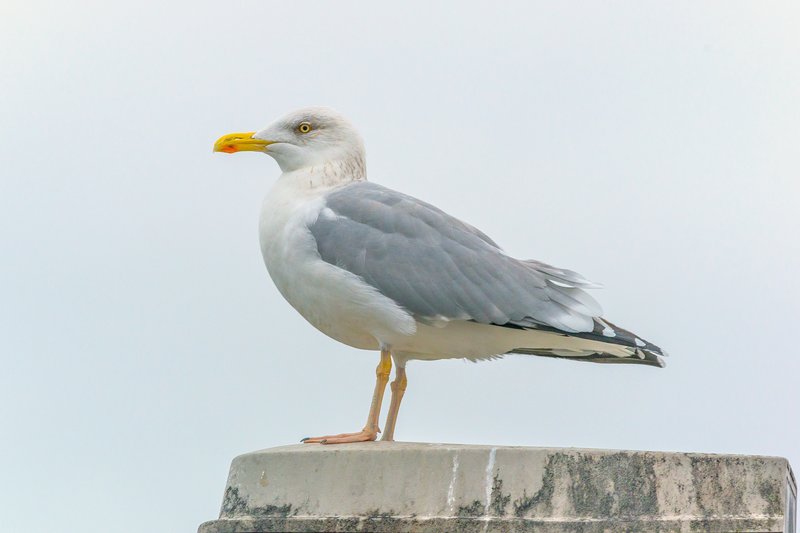
Adults have a light grey back and upper wings, white head and underparts, black wingtips with white “mirrors,” a yellow bill with a red spot, pale eyes, and usually pink legs. Juveniles and first-winter birds are mainly brown with darker streaks, dark bills, and dark eyes.
Where to find it
The Herring Gull breeds across much of north-western Europe and has been recorded on all European coasts, including the Mediterranean, and occasionally inland. Flocks keep a loose pecking order shaped by size, aggressiveness, and physical strength.
BirdBrain regions that include this bird
- Alaska
- Arctic
- California
- Eastern Canada
- Eastern Europe
- Florida
- Great Lakes
- Mexico
- Mid-Atlantic
- Northern Europe
- Plains
- Southeast
- Southern Europe
- Southwest
- Texas
- Western Canada
- Western Europe
Did you know?
- Its loud, laughing call is often seen as a symbol of the seaside in countries such as the United Kingdom.
- European herring gulls can see ultraviolet light.
- Adult males usually dominate feeding and boundary disputes, while adult females typically dominate nest-site selection.
Learn the Herring Gull by ear
BirdBrain Academy teaches bird sounds with side-by-side listening and quizzes that use different recordings, so you learn the bird rather than one clip. Start with six free lessons, no signup needed. On your phone, Sound ID can name the birds singing around you.
Related birds
 American AvocetShorebirds
 American CrowCorvids
 American GoldfinchFinches
 American KestrelFalcons
 American RobinThrushes
 American Tree SparrowSparrows
Species notes are adapted from Wikipedia, available under CC BY-SA 4.0, and checked for BirdBrain. Recordings come from xeno-canto under the licenses shown with each one. Photo: Bengt Nyman from Vaxholm, Sweden, CC BY 2.0, via Wikimedia Commons. Identification guidance is educational; birds vary, so confirm unusual sightings with local experts or eBird.