 BirdBrain Academy
Ibises and Spoonbills · Threskiornithidae
Glossy Ibis sounds
Plegadis falcinellus
The Glossy Ibis is a widespread water bird with a sickle-shaped bill and a quiet presence in warm wetlands.
Listen to the Glossy Ibis
Each recording below is a short excerpt with its spectrogram, a picture of the sound. Time runs left to right and higher pitches sit higher up. Play each one, then look for the same shape in the next. Different recordings of the same bird help you learn the bird, not one clip.


What to listen for
The Glossy Ibis is described as rather quiet, giving a variety of croaks and grunts, including a hoarse breeding sound.
Many listeners write its call as “grrrr”. Treat a written sound as a memory aid; individual birds and regions vary.
What it looks like
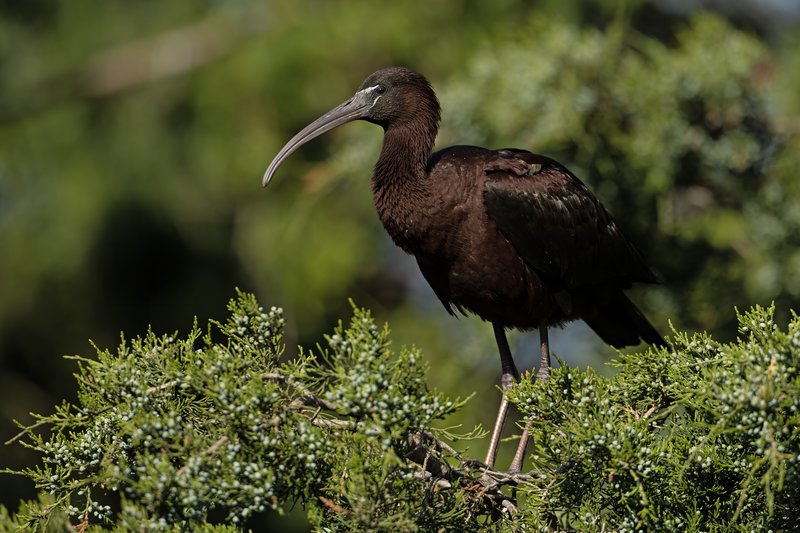
The Glossy Ibis is a mid-sized ibis, 48–66 cm long, with an 80–105 cm wingspan. Breeding adults have reddish-brown bodies, strongly iridescent green-to-bronze or purple wing feathers, a narrow white facial band, a brownish bill, and red-brown legs.
Where to find it
It feeds in very shallow water and nests in freshwater or brackish wetlands with dense emergent vegetation, low trees, or bushes. Glossy Ibises are nomadic outside breeding, often migrating broadly, foraging in small flocks, and roosting communally at night.
BirdBrain regions that include this bird
- Andean Region
- Australia
- Caribbean
- Eastern Africa
- Eastern Canada
- Eastern Europe
- Florida
- Great Lakes
- Mid-Atlantic
- Middle East
- Northern South America
- Plains
- Polynesia
- South Asia
- Southeast
- Southern Africa
- Southern Europe
- Texas
- Western Europe
Did you know?
- Its scientific name comes from Greek and Latin words meaning “sickle,” referring to the bill shape.
- The historical name “black curlew” was used in Norfolk at least until the early 19th century.
- It is described as the most widespread ibis species.
Learn the Glossy Ibis by ear
BirdBrain Academy teaches bird sounds with side-by-side listening and quizzes that use different recordings, so you learn the bird rather than one clip. Start with six free lessons, no signup needed. On your phone, Sound ID can name the birds singing around you.
Related birds
 White IbisIbises and Spoonbills
 American AvocetShorebirds
 American CrowCorvids
 American GoldfinchFinches
 American KestrelFalcons
 American RobinThrushes
Species notes are adapted from Wikipedia, available under CC BY-SA 4.0, and checked for BirdBrain. Recordings come from xeno-canto under the licenses shown with each one. Photo: Chuck Homler, Focus On Wildlife, CC BY-SA 4.0, via Wikimedia Commons. Identification guidance is educational; birds vary, so confirm unusual sightings with local experts or eBird.