 BirdBrain Academy
Cormorants · Phalacrocoracidae
Double-crested Cormorant sounds
Nannopterum auritum
A black North American water bird of rivers, lakes, and coasts, the Double-crested Cormorant dives for fish and dries its wings afterward.

Listen to the Double-crested Cormorant
Each recording below is a short excerpt with its spectrogram, a picture of the sound. Time runs left to right and higher pitches sit higher up. Play each one, then look for the same shape in the next. Different recordings of the same bird help you learn the bird, not one clip.

Recorded by Jonathon Jongsma, Powderhorn Park, Minneapolis, Hennepin, Minnesota, 2014-05-08. XC177731 on xeno-canto, CC BY-SA 4.0. Five-second excerpt.

Recorded by Jonathon Jongsma, Powderhorn Park, Minneapolis, Hennepin, Minnesota, 2012-08-31. XC109541 on xeno-canto, CC BY-SA 3.0. Five-second excerpt.

Recorded by Jonathon Jongsma, Powderhorn Park, Minneapolis, Hennepin, Minnesota, 2014-05-08. XC177731 on xeno-canto, CC BY-SA 4.0. Five-second excerpt.
What to listen for
What it looks like
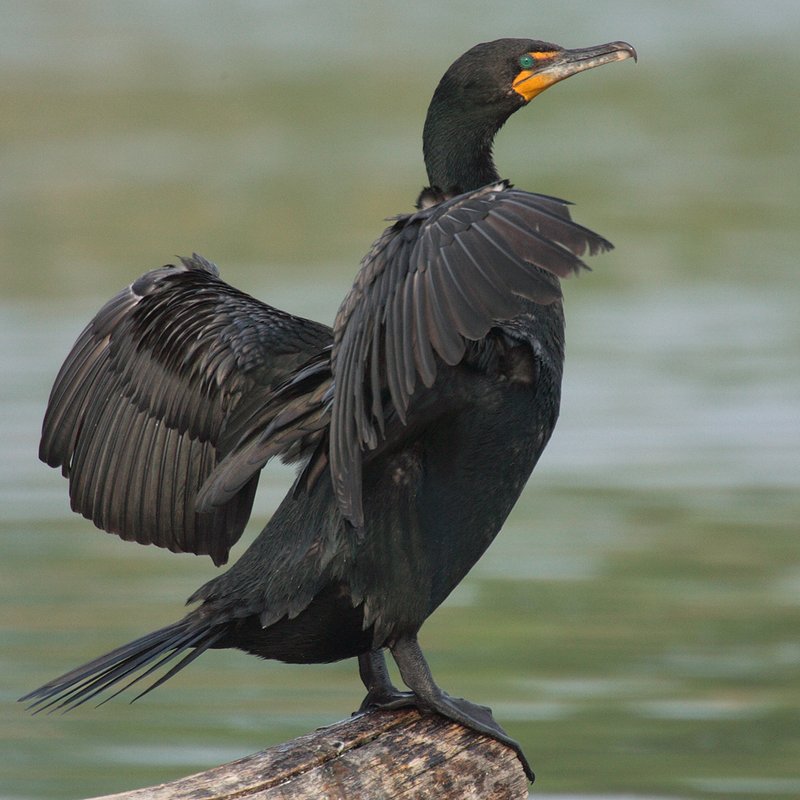
The Double-crested Cormorant is a large, stocky waterbird with a long neck, webbed feet, a medium hooked bill, and dark plumage. Breeding adults are mostly black with orange facial skin and paired crests above the eyes, while juveniles are browner with paler throats and breasts.
Where to find it
It lives near rivers, lakes, and coastal waters across much of North America, wintering where waters remain ice-free. It swims low, dives from the surface, and often stands with wings spread to dry after fishing.
BirdBrain regions that include this bird
- Alaska
- California
- Caribbean
- Eastern Canada
- Florida
- Great Lakes
- Mexico
- Mid-Atlantic
- New England
- Northwest
- Plains
- Rocky Mountains
- Southeast
- Southwest
- Texas
- Western Canada
Did you know?
- Its feathers are not fully waterproof, so it must dry them after time in the water.
- It can dive 1.5 to 7.5 meters for 30 to 70 seconds.
- It sometimes leaves colonies in long, single-file lines over the water.
Learn the Double-crested Cormorant by ear
BirdBrain Academy teaches bird sounds with side-by-side listening and quizzes that use different recordings, so you learn the bird rather than one clip. Start with six free lessons, no signup needed. On your phone, Sound ID can name the birds singing around you.
Related birds
 American AvocetShorebirds
 American CrowCorvids
 American GoldfinchFinches
 American KestrelFalcons
 American RobinThrushes
 American Tree SparrowSparrows
Species notes are adapted from Wikipedia, available under CC BY-SA 4.0, and checked for BirdBrain. Recordings come from xeno-canto under the licenses shown with each one. Photo: Mdf, CC BY-SA 3.0, via Wikimedia Commons. Identification guidance is educational; birds vary, so confirm unusual sightings with local experts or eBird.