 BirdBrain Academy
Waxwings · Bombycillidae
Cedar Waxwing sounds
Bombycilla cedrorum
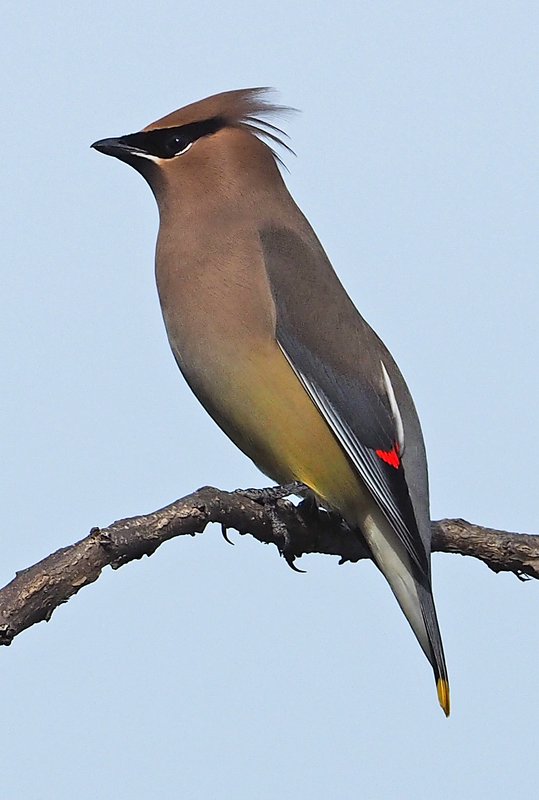
The Cedar Waxwing is a sleek North and Central American waxwing, brown, gray, and yellow, with red wax-like wing tips.

Listen to the Cedar Waxwing
Each recording below is a short excerpt with its spectrogram, a picture of the sound. Time runs left to right and higher pitches sit higher up. Play each one, then look for the same shape in the next. Different recordings of the same bird help you learn the bird, not one clip.

Recorded by Jonathon Jongsma, Union Bay Campground, Porcupine Mountains SP, Ontonagon, Michigan, 2013-07-11. XC142622 on xeno-canto, CC BY-SA 3.0. Five-second excerpt.

Recorded by steve, Durham, Orange County, North Carolina, 2023-05-10. XC799645 on xeno-canto, CC BY-SA 4.0. Five-second excerpt.

Recorded by Jonathon Jongsma, Grey Cloud Dunes SNA, Washington, Minnesota, 2012-06-02. XC107623 on xeno-canto, CC BY-SA 3.0. Five-second excerpt.
What to listen for
The Cedar Waxwing gives very high-pitched whistles and buzzy trills about half a second long. Its voice is also described as high, thin whistles, heard often in flight.
Many listeners write its call as “see”. Treat a written sound as a memory aid; individual birds and regions vary.
What it looks like
Cedar Waxwings are medium-sized birds, about 6–7 inches long, with silky brown, gray, and lemon-yellow plumage, a subdued crest, black mask, and red wax-like wing tips. Adults have a pale yellow belly, a short square-tipped tail, and males and females look alike.
Where to find it
They favor trees along woodland edges, fruiting trees, and places near water, including parkland, golf courses, cemeteries, farms, orchards, and gardens. Sociable and non-territorial, they gather in flocks year-round and move with the berry supply.
BirdBrain regions that include this bird
- Alaska
- Andean Region
- California
- Caribbean
- Central America
- Eastern Canada
- Florida
- Great Lakes
- Mexico
- Mid-Atlantic
- New England
- Northern South America
- Northwest
- Plains
- Polynesia
- Rocky Mountains
- Southeast
- Southwest
- Texas
- Western Canada
Did you know?
- The red tips on the wing feathers resemble sealing wax, giving the Cedar Waxwing its common name.
- Cedar Waxwings are non-territorial and will often groom each other.
- They are also known as the southern waxwing, Canada robin, cedar bird, cherry bird, or recellet.
Learn the Cedar Waxwing by ear
BirdBrain Academy teaches bird sounds with side-by-side listening and quizzes that use different recordings, so you learn the bird rather than one clip. Start with six free lessons, no signup needed. On your phone, Sound ID can name the birds singing around you.
Related birds
 American AvocetShorebirds
 American CrowCorvids
 American GoldfinchFinches
 American KestrelFalcons
 American RobinThrushes
 American Tree SparrowSparrows
Species notes are adapted from Wikipedia, available under CC BY-SA 4.0, and checked for BirdBrain. Recordings come from xeno-canto under the licenses shown with each one. Photo: Judy Gallagher, CC BY 2.0, via Wikimedia Commons. Identification guidance is educational; birds vary, so confirm unusual sightings with local experts or eBird.