 BirdBrain Academy
Corvids · Corvidae
Blue Jay sounds
Cyanocitta cristata
The Blue Jay is a blue-crested corvid of eastern North America, common in forests and residential areas.

Listen to the Blue Jay
Each recording below is a short excerpt with its spectrogram, a picture of the sound. Time runs left to right and higher pitches sit higher up. Play each one, then look for the same shape in the next. Different recordings of the same bird help you learn the bird, not one clip.

Recorded by Jonathon Jongsma, Miesville Ravine Park Reserve, Goodhue County, Minnesota, 2014-04-18. XC175223 on xeno-canto, CC BY-SA 4.0. Five-second excerpt.
What to listen for
The Blue Jay has a varied voice, including a loud, gull-like alarm scream and quiet calls used at close range. It can copy local hawks so closely that the source may be difficult to tell.
Many listeners write its call as “jayer-jayer”. Treat a written sound as a memory aid; individual birds and regions vary.
What it looks like
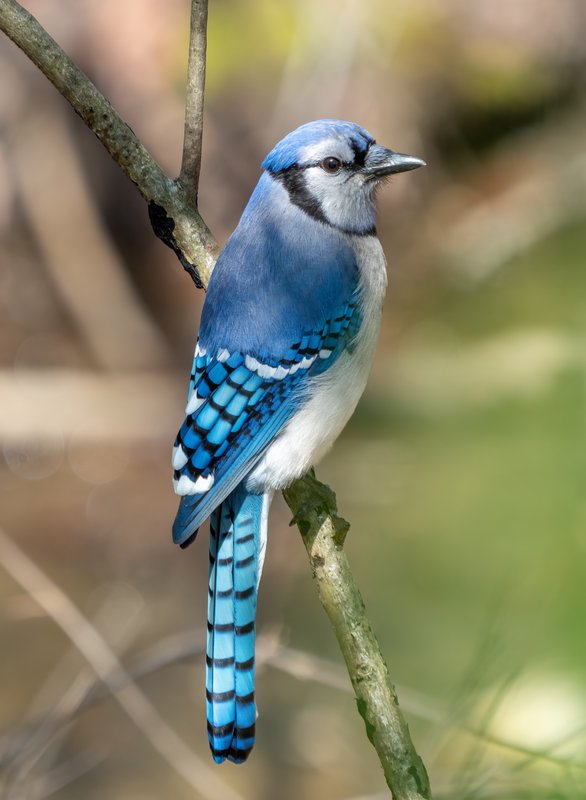
The Blue Jay measures 22-30 cm from bill to tail, with a 34-43 cm wingspan and a pronounced crest that rises or lowers with mood. Its plumage is lavender-blue to mid-blue above, with a white face, off-white underside, black collar, and barred wings and tail.
Where to find it
It ranges from southern Canada through the eastern and central United States, favoring mixed woodlands with oaks and beeches while also thriving in parks and residential areas. Bold and noisy, it may mob predators, raid nests, chase other birds from feeders, and mimic hawks.
BirdBrain regions that include this bird
- California
- Caribbean
- Eastern Canada
- Florida
- Great Lakes
- Mexico
- Mid-Atlantic
- New England
- Northwest
- Plains
- Rocky Mountains
- Southeast
- Southwest
- Texas
- Western Canada
Did you know?
- The crest rises when the Blue Jay is excited or aggressive, and flattens when it is feeding or resting.
- Its blue color comes from feather structure, not blue pigment.
- Blue Jays have been observed using tools in captivity and in the wild.
Learn the Blue Jay by ear
BirdBrain Academy teaches bird sounds with side-by-side listening and quizzes that use different recordings, so you learn the bird rather than one clip. Start with six free lessons, no signup needed. On your phone, Sound ID can name the birds singing around you.
Related birds
 American CrowCorvids
 American AvocetShorebirds
 American GoldfinchFinches
 American KestrelFalcons
 American RobinThrushes
 American Tree SparrowSparrows
Species notes are adapted from Wikipedia, available under CC BY-SA 4.0, and checked for BirdBrain. Recordings come from xeno-canto under the licenses shown with each one. Photo: Rhododendrites, CC BY-SA 4.0, via Wikimedia Commons. Identification guidance is educational; birds vary, so confirm unusual sightings with local experts or eBird.