 BirdBrain Academy
Titmice and Chickadees · Paridae
Black-capped Chickadee sounds
Poecile atricapillus
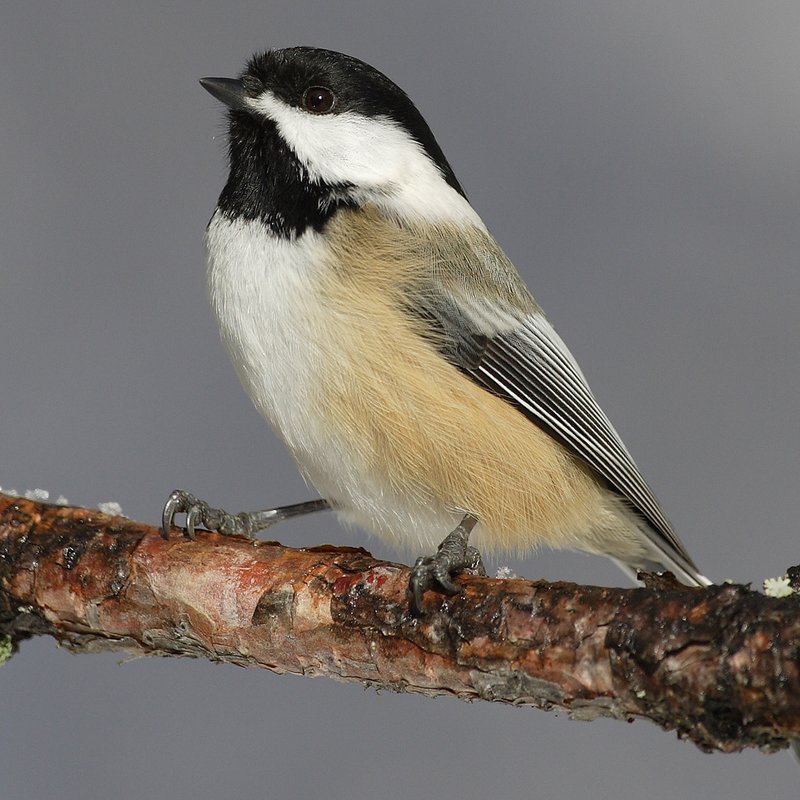
The Black-capped Chickadee is a small, nonmigratory North American passerine of deciduous and mixed forests, marked by a black cap and bib.

Listen to the Black-capped Chickadee
Each recording below is a short excerpt with its spectrogram, a picture of the sound. Time runs left to right and higher pitches sit higher up. Play each one, then look for the same shape in the next. Different recordings of the same bird help you learn the bird, not one clip.

Recorded by Doug Hynes, Whitbourne, Newfoundland and Labrador, 2011-03-09. XC935615 on xeno-canto, CC BY-SA 4.0. Five-second excerpt.

Recorded by Eric B, Turkey Hill (near Arlington), Middlesex County, Massachusetts, 2020-06-16. XC569276 on xeno-canto, CC BY-SA 4.0. Five-second excerpt.

Recorded by Jonathon Jongsma, Minnesota Valley NWR, Cliff Fen, Dakota, Minnesota, 2014-01-12. XC164791 on xeno-canto, CC BY-SA 3.0. Five-second excerpt.
What to listen for
The Black-capped Chickadee has highly complex vocalizations, including a clear two-note song and its familiar name-giving call. The call can vary to communicate predator threats and group movement, with more repeated notes signaling greater danger.
Many listeners write its call as “fee-bee”. Treat a written sound as a memory aid; individual birds and regions vary.
When you are most likely to hear it: Year-round for the chick-a-dee-dee-dee call..
What it looks like
The Black-capped Chickadee has a black cap and bib, white cheeks, white underparts with buff flanks, a greenish gray back, and slate-gray wings and tail. Both sexes weigh 10–14 g and look much alike, though males generally have a larger bib.
Where to find it
It lives across much of North America in wooded places, including coniferous and deciduous forests, urban parks, willow thickets, and suburbs. It forages along branches, may hang upside down or hover, caches food, and forms winter flocks with other birds.
BirdBrain regions that include this bird
- Alaska
- California
- Eastern Canada
- Great Lakes
- Mid-Atlantic
- New England
- Northwest
- Plains
- Rocky Mountains
- Southeast
- Southwest
- Western Canada
Did you know?
- The chick-a-dee-dee-dee call gave the Black-capped Chickadee its name.
- It caches food for winter, and memory for cache locations can last up to 28 days.
- On cold winter nights, it can lower body temperature by as much as 12°C to conserve energy.
Learn the Black-capped Chickadee by ear
BirdBrain Academy teaches bird sounds with side-by-side listening and quizzes that use different recordings, so you learn the bird rather than one clip. Start with six free lessons, no signup needed. On your phone, Sound ID can name the birds singing around you.
Related birds
 Carolina ChickadeeTitmice and Chickadees
 Tufted TitmouseTitmice and Chickadees
 American AvocetShorebirds
 American CrowCorvids
 American GoldfinchFinches
 American KestrelFalcons
Species notes are adapted from Wikipedia, available under CC BY-SA 4.0, and checked for BirdBrain. Recordings come from xeno-canto under the licenses shown with each one. Photo: Mdf, CC BY-SA 3.0, via Wikimedia Commons. Identification guidance is educational; birds vary, so confirm unusual sightings with local experts or eBird.